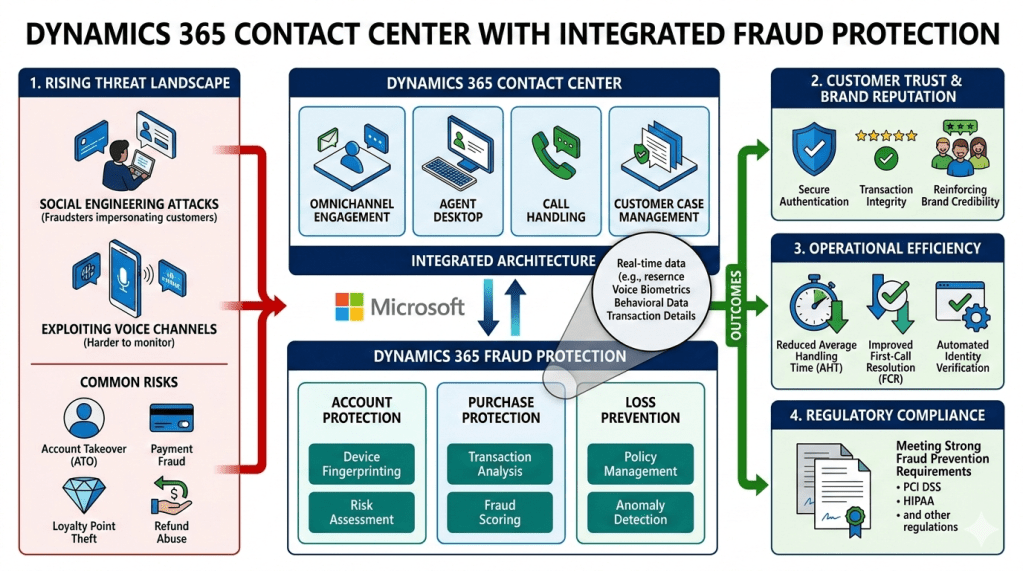
Contact centres are the beating heart of customer engagement. They handle millions of interactions daily across voice, chat, email, and digital channels. But with this central role comes vulnerability: fraudsters increasingly exploit contact centres as entry points for account takeovers, payment fraud, and identity theft.
Microsoft’s Dynamics 365 Fraud Protection offers a cloud-native solution to mitigate these risks. This paper explores why fraud protection is essential, how Dynamics 365 addresses it, and what licensing and SKUs are required to deploy it effectively.
2. The Growing Need for Fraud Protection
2.1 Fraud Trends in Contact Centres
Social Engineering: Fraudsters impersonate legitimate customers to gain access to accounts.
Synthetic Identities: Fake accounts created to exploit promotions or loyalty programs.
Account Takeover (ATO): Stolen credentials used to hijack customer accounts.
Refund Abuse: Exploiting return policies to gain financial advantage.
Payment Fraud: Unauthorized transactions processed through agents.
2.2 Impact on Organizations
Financial Losses: Billions lost annually to fraud in customer service channels.
Reputation Damage: Customers lose trust after a single breach.
Operational Strain: Agents spend more time verifying identities manually.
Regulatory Risk: Non-compliance with PCI DSS, GDPR, HIPAA, etc.
Microsoft’s Dynamics 365 Fraud Protection is a SaaS solution designed to safeguard organizations against fraud across digital and contact center channels.
3.1 Core Modules
Account Protection (AP)
Detects fraudulent account creation and login attempts.
Uses AI models to flag suspicious activity.
Purchase Protection (PP)
Evaluates online payment transactions for fraud risk.
Integrates with payment processors to reduce chargebacks.
Loss Prevention (LP)
Identifies fraud in returns, discounts, and loyalty programs.
Helps retailers and service providers reduce abuse.
3.2 Integration with Contact Centres
Seamlessly integrates with Dynamics 365 Contact Center.
Provides real-time fraud scoring during customer interactions.
Enhances Nuance voice biometrics for secure authentication.
Reduces manual verification workload for agents.
4. Licensing & SKU Requirements
Fraud Protection is not included in Dynamics 365 Premium or Contact Center licenses. It requires separate licensing.
4.1 Base License
Dynamics 365 Fraud Protection Base License
Includes Account Protection, Purchase Protection, and Loss Prevention.
Cost: $1,000/month/tenant
Transaction allowances:
100,000 Account Protection transactions/month
2,000 Purchase Protection transactions/month
4,000 Loss Prevention transactions/month
4.2 Add-ons
Add-on
Coverage
Cost (approx.)
Account Protection Add-on
20K transactions/month
$150/month (<2M transactions) or $100/month (≥2M transactions)
Training needs: Agents must understand fraud alerts to act effectively.
9. Conclusion
Fraud protection in contact centres is essential for security, compliance, and customer trust. Microsoft’s Dynamics 365 Fraud Protection provides a modular solution, but it requires separate licensing beyond the Premium license.
The base SKU costs $1,000/month per tenant, with add-ons available for scaling transaction volumes. Organizations must carefully plan licensing to balance cost and coverage.
By integrating Fraud Protection with Dynamics 365 Contact Center and Nuance AI, businesses can reduce fraud, improve efficiency, and protect customer trust.
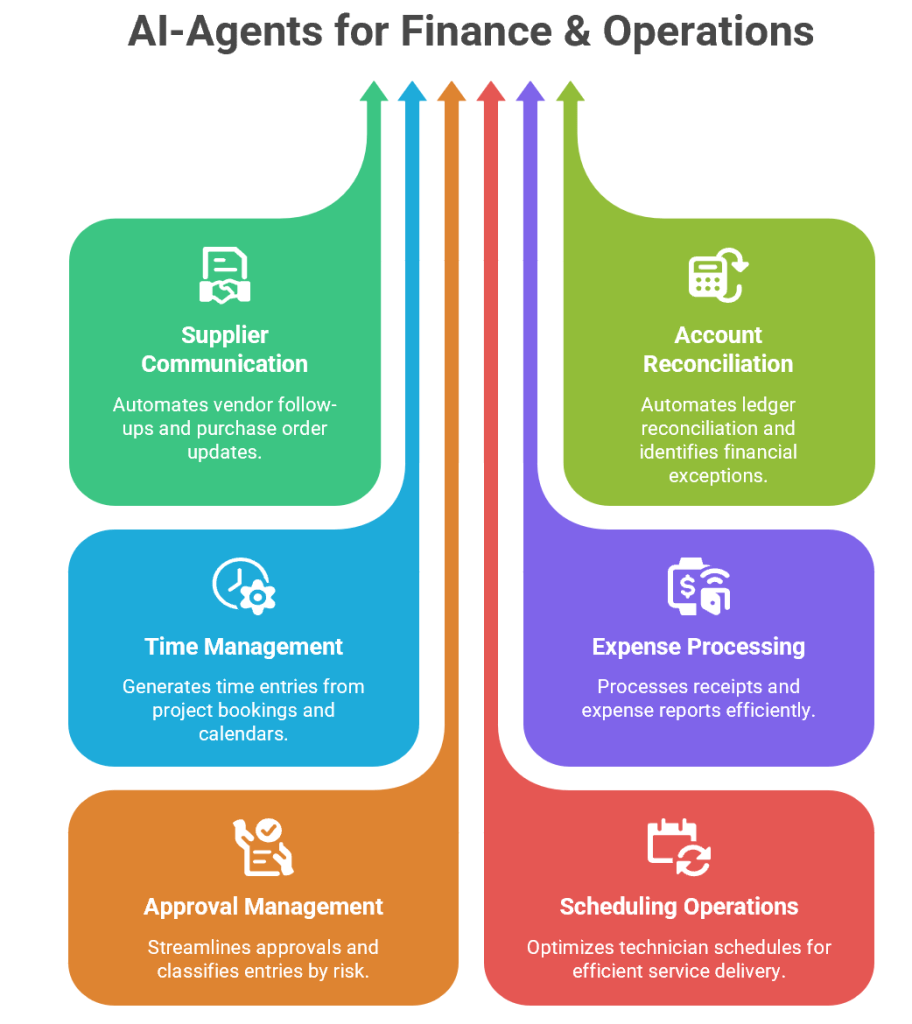
Finance and Operations (F&O) functions are the backbone of enterprise performance. They ensure that procurement, accounting, project management, expense handling, and operational monitoring run smoothly. Yet, these areas are often burdened with repetitive manual tasks, compliance risks, and inefficiencies.
Microsoft’s Dynamics 365 Finance and Operations Autonomous Agents are designed to address these challenges. By embedding AI-driven automation into core workflows, these agents free finance and operations teams to focus on strategic decision-making rather than routine administration.
1. Supplier Communication Agent
Purpose
Procurement teams spend significant time chasing suppliers for confirmations, updates, and changes. The Supplier Communication Agent automates these interactions, ensuring real-time visibility and freeing teams for strategic work.
How It Works
Automated Follow-Ups: Sends reminders to suppliers for pending confirmations.
Workflow Updates: Applies supplier changes directly to purchase orders.
Exception Escalation: Flags anomalies (e.g., delivery delays, pricing mismatches) for human review.
Real-Time Visibility: Updates dashboards with supplier responses.
Business Value
Reduces manual communication overhead.
Improves supplier relationship management.
Enhances procurement efficiency.
Provides transparency across supply chains.
Example
A manufacturing company issues 1,000 purchase orders monthly. The agent autonomously follows up with suppliers, applies changes to delivery dates, and escalates exceptions. Procurement managers focus on strategic sourcing rather than chasing confirmations.
2. Account Reconciliation Agent
Purpose
Financial reconciliation is critical but often tedious. The Account Reconciliation Agent automates ledger-to-subledger reconciliation, identifies exceptions, and suggests resolutions.
How It Works
Automated Matching: Compares ledger entries with subledger transactions.
Audit Trail: Maintains transparent logs for compliance.
Business Value
Accelerates financial closings.
Improves accuracy in reporting.
Reduces audit risks.
Frees accountants for strategic analysis.
Example
During month-end close, the agent reconciles thousands of transactions overnight, identifies 50 mismatches, and suggests corrections. Finance teams review exceptions instead of manually reconciling every entry.
3. Time Agent
Purpose
Manual time entry is error-prone and inefficient. The Time Agent generates time entries from project bookings, calendars, and Outlook meetings.
How It Works
Data Extraction: Pulls project schedules and meeting logs.
Time Entry Generation: Creates entries automatically in Dynamics 365.
Compliance Tracking: Ensures accurate revenue recognition.
Business Value
Saves employees time.
Improves billing accuracy.
Enhances compliance with project accounting standards.
Provides real-time visibility into resource utilization.
Example
A consulting firm’s employees spend hours logging time weekly. The agent automatically generates entries from Outlook calendars and project bookings, reducing errors and ensuring accurate client billing.
4. Expense Agent
Purpose
Expense management is often bogged down by manual receipt processing and policy enforcement. The Expense Agent automates this process.
How It Works
Receipt Extraction: Reads data from emails or images.
Policy Checks: Validates expenses against company rules.
Grouping Logic: Organizes reports by travel or project.
Compliance Enforcement: Flags violations for review.
Business Value
Accelerates reimbursements.
Ensures compliance with travel and expense policies.
Reduces fraud risk.
Improves employee satisfaction.
Example
An employee submits receipts via email. The agent extracts data, applies policy checks (e.g., meal limits, travel allowances), groups expenses by trip, and processes reimbursement automatically.
5. Approval Management Agent
Purpose
Approvals are critical but often slow. The Approval Management Agent streamlines this process by reviewing submissions against policy rules.
How It Works
Policy Validation: Checks entries against organizational rules.
Risk Classification: Flags high-risk items.
Routing: Sends flagged items to managers for review.
Efficiency: Automates approvals for compliant entries.
Business Value
Speeds up approval cycles.
Improves accuracy in compliance.
Reduces bottlenecks in workflows.
Enhances employee productivity.
Example
An expense report is submitted. The agent validates it against policy, approves compliant items instantly, and routes flagged entries (e.g., exceeding travel allowance) to managers.
6. Scheduling Operations Agent
Purpose
Resource scheduling is complex, requiring consideration of skillsets, travel time, and commitments. The Scheduling Operations Agent optimizes technician schedules.
How It Works
Skill Matching: Assigns tasks based on technician expertise.
Travel Optimization: Minimizes travel time between jobs.
Commitment Tracking: Ensures customer appointments are honored.
Dynamic Adjustments: Re-optimizes schedules in real time.
Business Value
Improves resource utilization.
Enhances customer satisfaction.
Reduces operational costs.
Provides agility in service delivery.
Example
A field service company manages hundreds of technicians. The agent optimizes schedules daily, ensuring the right technician is assigned to the right job, reducing travel time, and improving customer satisfaction.
7. Batch Monitoring Agent
Purpose
Batch processes are critical in finance and supply chain systems. The Batch Monitoring Agent provides AI-powered monitoring and diagnostics.
How It Works
Failure Detection: Identifies runtime anomalies and failures.
Throttling Alerts: Flags performance bottlenecks.
Diagnostics: Provides root cause analysis.
Operational Visibility: Updates dashboards with batch health.
Business Value
Ensures smooth batch execution.
Reduces downtime in financial and supply chain operations.
Improves IT administrator efficiency.
Enhances system reliability.
Example
During nightly batch runs, the agent detects throttling in invoice processing, alerts IT administrators, and suggests corrective actions. This prevents delays in financial reporting.
Synergy Between Agents
Together, these agents create a self-optimizing Finance and Operations ecosystem:
Supplier Communication Agent ensures procurement efficiency.
Scalability : Organizations can handle larger volumes of transactions without expanding headcount.
Conclusion
Dynamics 365 Finance and Operations Autonomous Agents represent a paradigm shift in enterprise management. By embedding AI into procurement, accounting, project management, expense handling, and system monitoring, they empower organizations to achieve greater efficiency, compliance, and scalability.
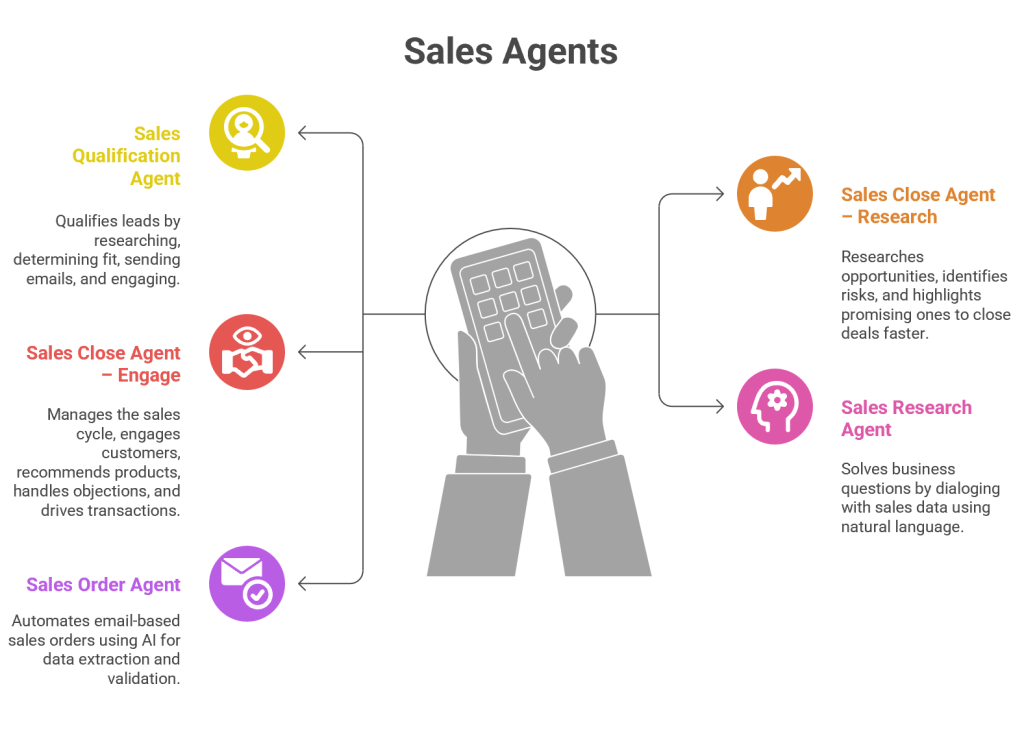
Sales organizations today face increasing complexity: fragmented customer journeys, rising expectations for personalization, and the need to close deals faster in competitive markets. Microsoft’s Dynamics 365 Sales Autonomous Agents are designed to address these challenges by embedding generative AI and automation directly into the sales lifecycle.
These agents act as digital colleagues, autonomously handling repetitive tasks, researching opportunities, qualifying leads, and even engaging customers. By doing so, they free human sellers to focus on relationship-building and strategic deal closure.
1. Sales Qualification Agent
Purpose
The Sales Qualification Agent helps sales teams qualify leads effortlessly by autonomously researching prospects, determining fit, and initiating outreach. Lead qualification is traditionally time-consuming, requiring sellers to manually gather data, assess potential, and decide whether to pursue.
How It Works
Data Aggregation: Pulls information from CRM, LinkedIn, company websites, and public databases.
Fit Analysis: Uses AI models to score leads based on industry, company size, buying signals, and past interactions.
Outreach Automation: Sends personalized emails to leads, initiating engagement.
Lead Engagement: Tracks responses and autonomously nurtures leads until they’re ready for human intervention.
Business Value
Reduces wasted effort on low-quality leads.
Ensures sellers focus on high-potential opportunities.
Increases conversion rates by engaging leads faster.
Provides consistent qualification criteria across teams.
Example
A software company receives 500 leads from a webinar. The Sales Qualification Agent researches each lead, identifies 120 as high-potential based on company size and budget, sends personalized outreach emails, and nurtures responses. Sellers only step in once leads show strong buying intent.
2. Sales Close Agent – Research
Purpose
Closing deals requires deep research into opportunities, risks, and customer needs. The Sales Close Agent – Research autonomously performs this research, providing sellers with actionable insights.
How It Works
Opportunity Analysis: Reviews CRM data, competitor activity, and customer history.
Opportunity Highlighting: Identifies promising deals with high likelihood of closure.
Insight Delivery: Provides sellers with concise research summaries.
Business Value
Saves sellers hours of manual research.
Improves win rates by highlighting risks early.
Enhances pipeline visibility for managers.
Enables sellers to focus on strategy rather than data gathering.
Example
A manufacturing company is negotiating with a large retailer. The agent discovers that the retailer recently expanded into new markets, signalling increased demand. It also flags a risk: the retailer is evaluating a competitor. Sellers use this insight to tailor their pitch and mitigate risks.
3. Sales Close Agent – Engage
Purpose
The Sales Close Agent – Engage goes beyond research—it autonomously manages the end-to-end sales cycle, engaging customers, recommending products, handling objections, and driving transactions to closure.
How It Works
Customer Engagement: Initiates conversations via email, chat, or voice.
Product Recommendations: Suggests products based on customer profile and past purchases.
Objection Handling: Uses AI-driven scripts to address common objections.
Transaction Closure: Drives deals to completion with templated personalization for outreach and follow-ups.
Business Value
Automates repetitive engagement tasks.
Ensures consistent messaging across customers.
Accelerates deal closure by maintaining momentum.
Provides scalability—handling hundreds of opportunities simultaneously.
Example
In a SaaS company, the agent engages mid-tier prospects by recommending product bundles, addressing objections like “Is this scalable?” with pre-approved responses, and scheduling demos. Sellers step in only for high-value negotiations, while the agent autonomously closes smaller deals.
4. Sales Research Agent
Purpose
Sales teams often need to answer complex business questions: Which industries are showing growth? Which customers are at risk of churn? The Sales Research Agent enables sellers to query their sales data using natural language.
How It Works
Natural Language Interface: Sellers ask questions like “Show me top opportunities in healthcare this quarter.”
Data Querying: The agent translates queries into structured searches across CRM and analytics systems.
Insight Generation: Provides answers in plain language, charts, or dashboards.
Democratizes access to sales insights—no need for data analysts.
Speeds up decision-making with instant answers.
Improves pipeline visibility and forecasting accuracy.
Empowers sellers with data-driven strategies.
Example
A sales manager asks: “Which deals are at risk of delay due to budget approvals?” The agent scans CRM notes, identifies 15 deals with flagged budget issues, and presents them in a dashboard. The manager reallocates resources accordingly.
5. Sales Order Agent
Purpose
Processing sales orders is often manual, error-prone, and time-consuming. The Sales Order Agent automates this process using AI for data extraction and validation.
How It Works
Email Parsing: Extracts order details from customer emails.
Data Validation: Checks product codes, quantities, and pricing against CRM.
Order Creation: Automatically generates orders in Dynamics 365.
Speeds up order processing, enhancing customer satisfaction.
Scales order handling without increasing headcount.
Example
A distributor receives hundreds of email-based orders daily. The agent extracts details, validates them, creates orders, and sends confirmations. Exceptions (like missing product codes) are routed to human staff. This reduces processing time from hours to minutes.
Synergy Between Agents
Together, these agents create a self-optimizing sales ecosystem:
Sales Qualification Agent ensures only high-quality leads enter the pipeline.
Sales Close Agents (Research + Engage) accelerate deal closure.
Sales Research Agent empowers sellers with instant insights.
Sales Order Agent automates post-sale processes.
This synergy transforms Dynamics 365 Sales into a comprehensive AI-driven sales engine.
Strategic Impact
Operational Efficiency : Agents automate repetitive tasks, freeing sellers to focus on strategic activities.
Customer Experience : Personalized, timely engagement improves satisfaction and loyalty.
Revenue Growth : Faster qualification, research, and closure increase win rates and shorten sales cycles.
Scalability : Organizations can handle larger volumes of leads and orders without expanding headcount.
Conclusion
Dynamics 365 Sales Autonomous Agents represent a paradigm shift in sales operations. By embedding AI into every stage of the sales lifecycle—from lead qualification to order processing—they empower organizations to achieve greater efficiency, accuracy, and customer satisfaction.
These agents are not just tools; they are digital sales colleagues that work alongside human sellers, ensuring that sales organizations remain competitive in an increasingly complex marketplace.
This document outlines the technical architecture of an advanced lead management and customer relationship ecosystem from one of my past implementations of an insurance company. The system integrates multiple SaaS and cloud platforms to create a seamless, real-time, and data-driven workflow for capturing, qualifying, and converting leads. At its core, it leverages the strengths of Salesforce for marketing orchestration, Dynamics 365 for core sales and service, Microsoft Azure for real-time lead ingestion and intelligent orchestration, and Microsoft Fabric as a unified data platform for comprehensive data warehousing and AI-powered lead scoring. The primary goal is to provide sales and marketing teams with a complete, 360-degree view of the customer while dynamically optimizing lead prioritization through sophisticated AI models.
Section 1: Architecture Overview
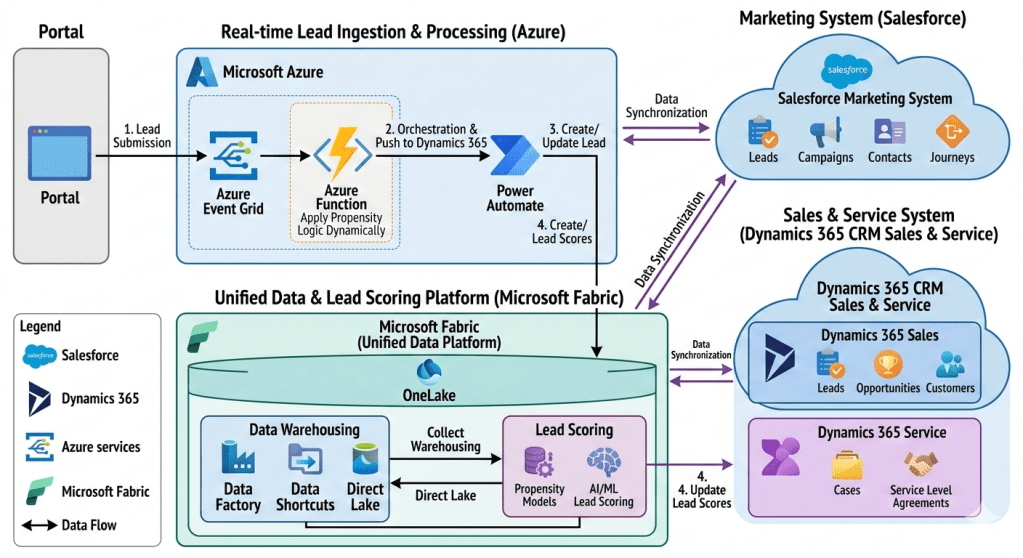
The architecture is structured into four main functional areas, connected by robust data flows and integration points:
Lead Ingestion Point: Represented by the ‘Portal,’ this is the primary source for all incoming leads.
Real-time Lead Ingestion & Processing (Microsoft Azure): This cloud-native layer captures lead data, applies initial dynamic logic, and orchestrates the creation of lead records in the CRM system.
CRM Ecosystem (Salesforce and Dynamics 365): A best-of-breed CRM strategy where specialized systems manage distinct customer relationship lifecycle phases:
Dynamics 365 CRM Sales & Service: Acts as the primary CRM for sales teams (managing leads, opportunities, and customers) and service teams (managing cases and SLAs).
Unified Data & Lead Scoring Platform (Microsoft Fabric): The analytical heart of the system, consolidating data from all platforms into a single logical data lake (OneLake) for data warehousing and to fuel advanced AI/ML lead scoring.
Section 2: External Lead Ingestion
2.1 The Portal
The entire workflow begins at the ‘Portal’ block on the far left. The Portal is a public-facing web application, landing page, or external system where potential leads submit their information via a web form. This form captures essential details such as name, email address, company, job title, and the lead’s specific interests. This action is crucial as it creates the initial ‘digital footprint’ of the lead.
Section 3: Real-time Lead Ingestion & Processing with Microsoft Azure
Once a lead submits information via the Portal, the system transitions into real-time processing within the Microsoft Azure ecosystem. This section is designed for low-latency, event-driven operations, ensuring no lead is missed and initial classification is instant.
3.1 Step 1: Lead Submission (Portal to Azure Event Grid)
The first numbered step shows data flowing from the Portal to ‘Azure Event Grid’. When a lead form is submitted, the Portal generates a standard ‘Lead Created’ event. This event is published to an Azure Event Grid topic, which acts as a highly scalable, real-time event routing service. This decoupling is essential: it allows the Portal to submit the lead instantly without waiting for subsequent, potentially slower processing steps, making the portal highly responsive.
3.2 Intelligent Processing (Azure Event Grid to Azure Function)
Azure Event Grid routes the incoming ‘Lead Created’ event to a subscribing Azure Function. This Azure Function, the central processing unit of the ingestion layer, is serverless, running code only when triggered. It is annotated with ‘Apply Propensity Logic Dynamically.’
The Azure Function’s Role and Dynamic Propensity Logic:
This is a critical, intelligent component. The Azure Function performs several immediate tasks:
Data Validation and Transformation: It parses the JSON payload from the Portal, validating data types and transforming it into a canonical lead format.
Applying Propensity Logic Dynamically: This is the application of lightweight, dynamic rules or a small, pre-trained machine learning model designed for instant action. “Dynamically” implies that these rules are not hard-coded but can be updated or fetched from a configuration system on the fly.
What this means: For example, the function could check a rule like: “If company size > 100 AND location = ‘USA’ AND product interest = ‘ILP’, then direct-route to the enterprise sales team via a special field.”
Propensity: At this stage, it’s not the full-scale, historical data-driven scoring done later in Fabric, but rather an initial “fit” check. The logic decides how to process the lead immediately: whether to flag it for rapid follow-up, categorize it based on dynamic business rules, or prepare specific metadata. The result of this logic is embedded into the lead record’s data payload.
Orchestration Trigger: Once initial logic is complete, the function triggers the next stage.
3.3 Step 2: Orchestration & Push to Dynamics 365 (Azure Function to Power Automate)
The Azure Function, having applied its initial logic and enriched the lead data, pushes the processed lead record to Power Automate via an HTTP connector. Power Automate is the orchestration engine for this phase, providing a low-code/no-code interface to manage the integration between Azure and the downstream CRM.
3.4 Step 3: Create/Update Lead (Power Automate to Dynamics 365 Sales)
The Power Automate flow takes the enriched lead data and performs an upsert operation (update or insert) into the ‘Dynamics 365 Sales’ module within the Dynamics 365 cloud.
The Power Automate Flow’s Role:
Dynamics 365 CRM Connector: The flow uses the standard Dynamics 365 CRM connector to authenticate and perform actions.
Lead Record Creation: If the lead is new (e.g., email not found in Dynamics 365), it creates a new ‘Lead’ record. The initial classification and metadata derived from the Azure Function’s dynamic logic are populated into the record.
Existing Lead Update: If the lead already exists, the flow updates the existing lead record, perhaps adding a new campaign activity.
This step ensures that the sales team has immediate access to a centralized, validated lead record in their primary CRM (Dynamics 365 Sales), enriched with initial intelligence from the ingestion layer.
Section 4: Primary CRM Ecosystem
The core customer relationship management activities are split between Salesforce and Dynamics 365, connected by continuous data synchronization.
4.1 Dynamics 365 CRM Sales & Service
Dynamics 365 CRM, the central cloud container on the right, is the primary application suite for sales and service teams.
Dynamics 365 Sales: This module contains essential CRM entity blocks:
Leads: As detailed above, leads created via Power Automate are stored here. Sales reps manage the lead qualification process within this module.
Opportunities: Qualified leads are converted into Opportunities, where sales teams manage the sales pipeline, track deals, and forecast revenue.
Customers: Once an opportunity is won, the lead is converted into a full customer record, including primary Account and Contact details.
Dynamics 365 Service: This module supports the customer after the sale:
Cases: It tracks all customer support requests and issues, providing service reps with a structured workflow to resolve problems.
Service Level Agreements (SLAs): It defines and manages the agreed-upon performance metrics for customer service (e.g., initial response time, resolution time), ensuring customer support meets predefined standards.
The combination of Sales and Service data within the single Dynamics 365 instance provides a foundational customer view for sales reps, showing them both pipeline activity and post-sales service interactions.
4.2 Salesforce Marketing System
The Salesforce cloud, in the upper right, is dedicated to advanced marketing operations. A “Data Synchronization” arrow shows continuous data exchange with the main Dynamics 365 Sales & Service container.
Marketing Data Entities:
Leads & Contacts: Salesforce Marketing maintains its own view of Leads and Contacts for marketing activities, synchronized from Dynamics 365. This includes historical lead behaviour.
Campaigns: This module manages marketing campaigns across various channels (email, social, web).
Journeys: This represents Salesforce Marketing Cloud’s “Journey Builder,” a powerful tool for designing and automating multi-channel customer journeys (e.g., welcome series, re-engagement campaigns) that deliver personalized messages at scale.
Salesforce is used because of its specialized marketing capabilities, while the actual sales process (opportunities, final customer conversion) resides in Dynamics 365. The data sync ensures that when a new lead is created in Dynamics 365, it flows to Salesforce to be nurtured; conversely, when a marketing campaign achieves a significant milestone (e.g., a lead hits a nurture goal), that information can be synchronized back to Dynamics 365 to update the lead’s status.
Section 5: Unified Data & Lead Scoring Platform (Microsoft Fabric)
This is the analytical foundation and most innovative section of the architecture. Microsoft Fabric acts as a single, unified analytics platform, consolidating data from all other systems into a single logical data lake to power both traditional reporting and advanced AI.
5.1 Data Ingestion into Microsoft Fabric (Sync Arrows and Ingestion Paths)
The diagram shows multiple arrows feeding data into Microsoft Fabric from Salesforce, Dynamics 365, and the lead ingestion stream.
Data Synchronization (Salesforce/Dynamics 365 <-> Microsoft Fabric): Arrows indicate data synchronization from both CRM systems into Fabric’s central OneLake. This provides the unified “360-degree view” by pulling marketing, sales, service, and lead history data into a single location.
Data Warehousing (Data Factory, Data Shortcuts, Direct Lake): These components illustrate how data is moved and unified:
Data Factory: Used to create complex ELT (Extract, Load, Transform) data pipelines, moving large volumes of data from various sources (perhaps legacy databases or other APIs) into OneLake.
Data Shortcuts: This is a crucial Fabric feature, allowing data to be left in its source location (like Azure Data Lake Storage Gen2 or AWS S3) while creating a “shortcut” that makes it appear as if it’s stored directly within OneLake. This eliminates the need for data duplication and extra movement.
Direct Lake: A high-performance capability in Microsoft Fabric that enables large data volumes stored in OneLake (in Delta Parquet format) to be loaded and queried directly by analytics tools (like Power BI) without intermediate data processing or caching, ensuring performance and “freshness.”
These tools combine to populate the unified OneLake with all relevant, normalized customer data.
Real-time Ingestion Path (Power Automate and Azure Function -> OneLake): In addition to the main sync, the diagram implies (via “Lead Ingestion” and “Direct Lake”) that real-time data from the initial lead ingestion (from the Azure Function/Power Automate flow) can be fed directly into OneLake, making new leads immediately available for the complex scoring process.
5.2 OneLake: The Unified Data Lake
At the center of Fabric is ‘OneLake.’ This is the foundational logical data lake, acting as the single source of truth for the entire organization. By implementing ” shortcuts,” OneLake physically might span multiple cloud locations, but it looks like a single, structured file system to any analytical service within Fabric. Data from Salesforce, Dynamics 365, and the real-time ingestion stream are all stored here.
5.3 Lead Scoring within Microsoft Fabric
This module is the core application for advanced, AI-powered lead scoring, which differs significantly from the initial “Propensity Logic” in the Azure Function. The full process within Fabric involves:
Data Unification: Aggregating data from OneLake, including:
Sales history (closed-won/lost opportunities from Dynamics 365 sync).
Customer service case history (from Dynamics 365 Service sync).
Real-time lead behaviour and attributes (from ingestion).
Propensity Models: Building and training advanced machine learning models (e.g., a predictive “propensity to buy” model) using historic data from OneLake.
AI/ML Lead Scoring: Applying these models to new leads. These sophisticated models can process hundreds of variables and identify non-obvious patterns to generate a highly precise, predictive lead score (e.g., from 1 to 100). This provides sales reps with a truly data-driven prediction of a lead’s likelihood to convert, which is far more powerful than the rules-based “propensity check” done at the ingestion point.
5.4 Step 4: Update Lead Scores (Fabric Lead Scoring to Dynamics 365 Sales)
The final numbered step closes the loop. After the AI/ML Lead Scoring process in Fabric generates an enhanced score, it pushes this score back to ‘Dynamics 365 Sales.’ This is done via an API connector or a scheduled data pipeline within Fabric (e.g., using Data Factory or a Spark job). The updated score populates a dedicated ‘Lead Score’ field on the original lead record in Dynamics 365 Sales.
This ensures sales teams work with the absolute best intelligence. A sales rep will now see a lead, created instantly from the portal, enriched with dynamic classification from the Azure Function, and continuously optimized with an AI-driven lead score from Fabric, allowing them to prioritize high-value opportunities with incredible precision.
Conclusion and Architecture Benefits
This detailed multi-cloud and multi-SaaS architecture provides several compelling advantages:
Best-of-Breed Specialization: It uses specialized platforms (Salesforce for marketing, Dynamics 365 for CRM core) without sacrificing data visibility, as both are integrated via bidirectional sync.
Intelligent, Real-time Ingestion: The combination of Azure Event Grid, Azure Functions (for dynamic logic), and Power Automate ensures all leads are captured, processed, and available in the CRM instantly, while immediately receiving a first pass of classification based on business rules.
Unified Customer View with Microsoft Fabric: The central OneLake provides a true “360-degree view,” consolidating data from Salesforce and Dynamics 365 (including sales and service) in one location, removing data silos.
Advanced AI Optimization (Continuous Improvement): The key differentiator is the AI-driven lead scoring within Fabric. It moves beyond simple rules and leverages historic data across the entire customer lifecycle to provide highly accurate, predictive prioritization, closing the loop with a score update in Dynamics 365. This ensures sales teams are always working on the leads with the highest dynamic and predictive propensity to buy.
Data Freshness and Efficiency: The use of Data Shortcuts and Direct Lake in Microsoft Fabric provides real-time access to large datasets without costly data movement or duplication, ensuring analytics are always based on current data.

 GM Dynamics & Agentic AI Consulting