“Approvals kit” – a kit from Power CAT that will accelerate building your approvals faster than ever – available as a public preview. Approvals kit is a no-code ready-made kit built on top of Power Platform components that allows your organization to configure sophisticated approvals such as conditional branching, delegation, admin overrides and more – all without the need to write a single code – empowering every person in your organization to “do more with less” for your organization’s approval needs.
Approvals Kit documentation https://aka.ms/ApprovalsKit : Public landing page of the kit, describes what and where approvals kit is along with usage personas and frequently asked questions.
Microsoft Copilot Studio, a low-code tool to customize Microsoft Copilot for Microsoft 365 and build standalone copilots. Copilot Studio is included in Copilot for Microsoft 365 and brings together a set of powerful conversational capabilities—from custom GPTs, to generative AI plugins, to manual topics—allowing you to:
Easily customize Copilot for Microsoft 365 with your own enterprise scenarios.
Quickly build, test, and publish standalone copilots and custom GPTs.
Manage and secure your customizations and standalone copilots with the right access, data, user controls, and analytics.
Let’s add an auto number field for the contact ID for which select/enter the required field information (Display name, Data type, Auto number Type, Format) as shown below
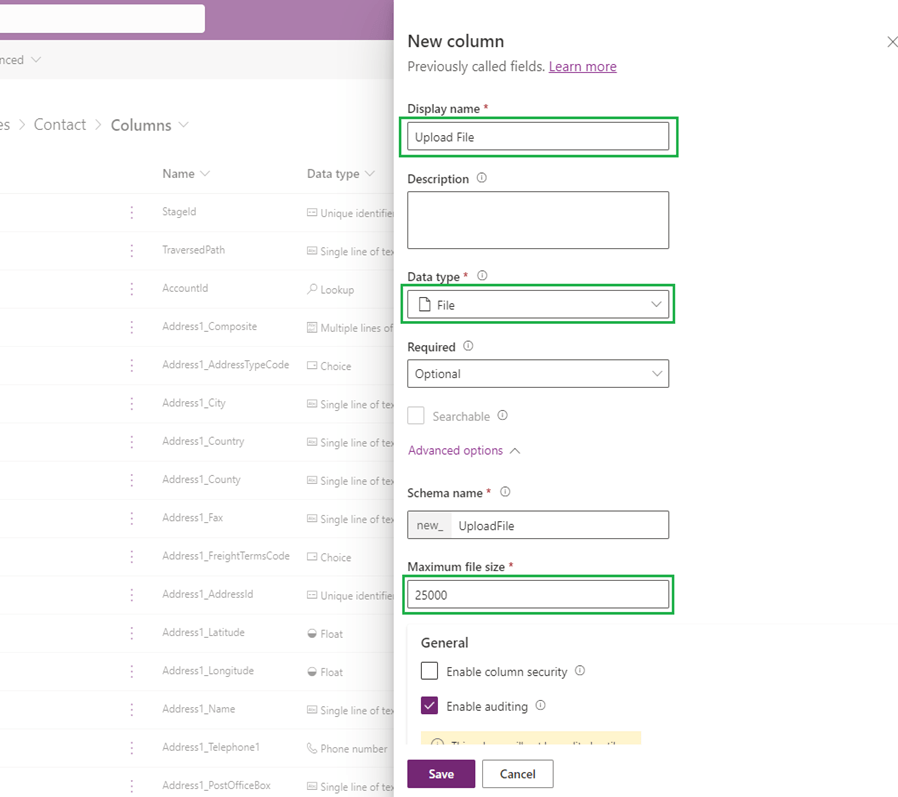
Let’s add another field type to upload file as shown below
These models are broadly classified 4 types based on operation –
Documents Type
This contains all the models which deals with documents
Prebuild Models
Invoice Processing
Extract information from invoices
Text Recognition
Extract all the text in photos and PDF documents (OCR)
Receipt Processing
Extract information from receipts
Identity Document Reader
Extract information from identity documents
Business Card Reader
Extract information from Business Cards
Custom Models
Document Processing
Extract custom information from documents
Document Type Models
Text Type
This contains all the models which deals with text analysis
Prebuild Models
Sentiment Analysis
Detect Positive, Negative, or neutral sentiment in text data
Category classification
Classify customer feedback into predefined categories
Entity Extraction
Extract key elements from text, and classifies them into predefined categories
Key Phrase Extraction
Extract most relevant words and phrases from text
Language Detection
Detect the predominant language of a text document
Text translation
Detect and translate more than 90 supported languages
Azure Open AI Service
Create text, answer questions, summarize documents and more with GPT
Custom Models
Category Classification
Classify texts into custom categories
Entity Extraction
Extract custom entities from your text
Structured Data
This contains model which deals with structure of data
Custom Models
Prediction
Predict future outcomes from historical data
Images
This contains models which deals with images
Prebuild Models
Text recognition
Extract all the text in photos and PDF documents (OCR)
Custom Models
Object Detection
Detect custom objects in images
Each model will pass through below 4 phases in sequence –
Build
Train
Manage
Publish
Build Model
To build a model using AI builder has below prerequisite –
AI builder requires Microsoft Dataverse storage to store and manage business data
AI builder must be enabled for the environment
Train Model
Before using AI builder models, you need to train the models. More the training of the model with different samples the confidence or accuracy will be more. So, training is a vital activity in AI automation.
Training takes some time in AI builder based on the level of difficulty so once the model is trained first time, you have access to details page where you can manage the model and you can see performance score of the models.
On the details page, training results appear in the last trained version section.
Manage Model
Optimising an AI model is an iterative process whose results can vary depending on the configurations you set and the training data you provide. Updating these factors can affect the performance of your model.
After model is trained a performance score will appear for each trained version so accordingly you can improve the model by adjusting the factors affecting the model.
After evaluation of model, you can check whether your model is perfectly fit, Underfit or Overfit
Underfit – This occurs when your model is not able to perform which is less than the expectation, in this case you need to train your model with more relevant information
Overfit – This occurs when your model gives accurate prediction for training data but not for new data, in this case you need to adjust relevant parameters and retrain the model
If your model is already once published, you will see one Published version and one Last Trained version which is not published yet after retraining. You can choose which one you want to use as final version to use and publish accordingly.
Publish Model
After the model is trained successfully you can publish to make it available. All users in your current environment will be able to use your published model when you publish it.



 GM Dynamics & Agentic AI Consulting